Digital Accessibility and SEBI: Making Investor Communication Inclusive in India
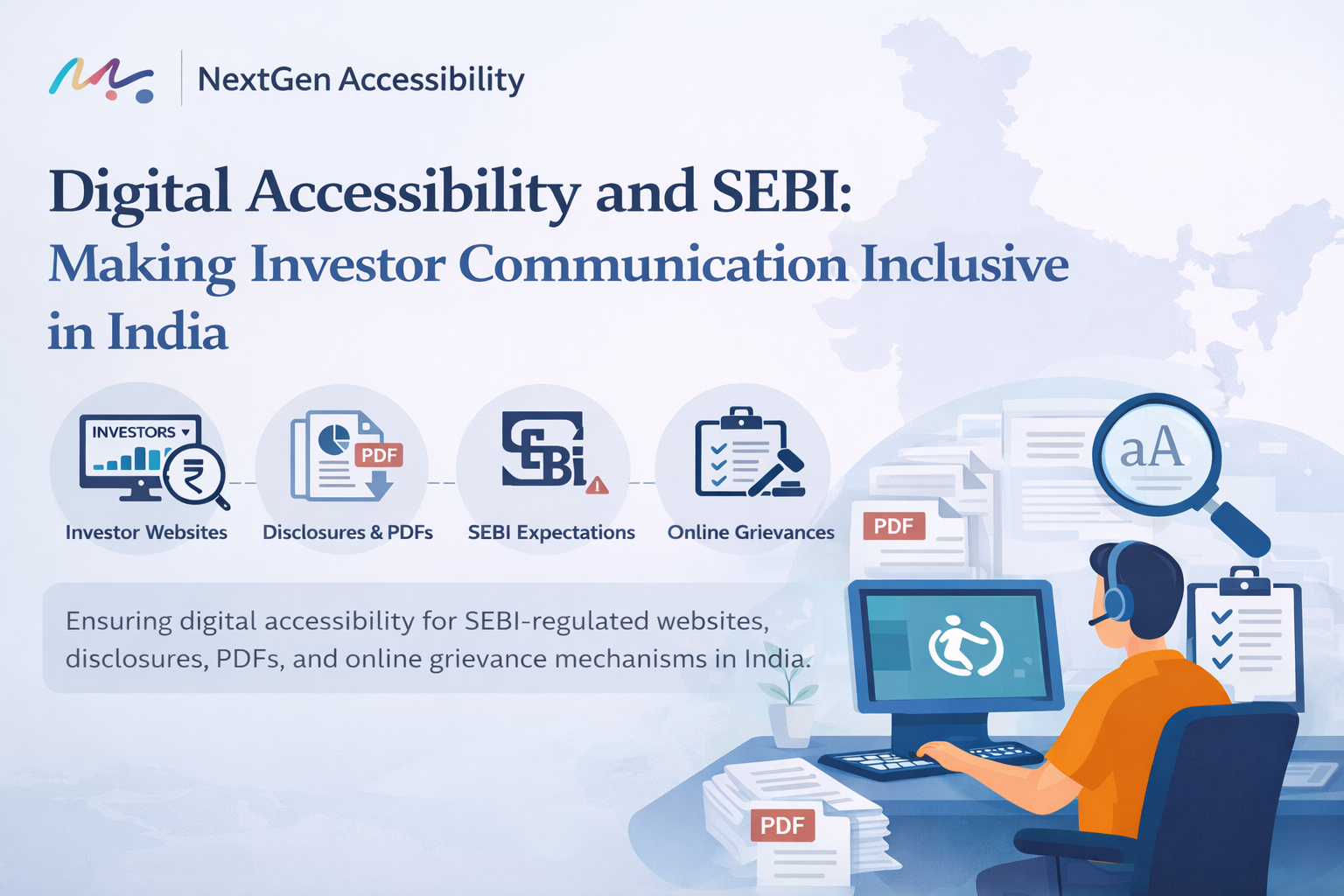
Explore the role of digital accessibility in SEBI-regulated investor communication, including websites, disclosures, PDFs, and online grievance mechanisms.
Digital transformation has significantly changed how investors interact with listed companies in India. Annual reports, financial disclosures, stock exchange filings, investor presentations, and grievance mechanisms are now primarily accessed through websites and digital platforms. As this shift accelerates, digital accessibility has become a critical but often overlooked aspect of investor communication.
For organisations regulated by the Securities and Exchange Board of India (SEBI), accessibility is no longer just a usability concern—it is closely linked to fairness, transparency, and equal access to information.
Accessibility and Investor Rights
Accessibility ensures that digital content can be used by everyone, including persons with visual, auditory, motor, or cognitive disabilities. Investors with disabilities rely on assistive technologies such as screen readers, keyboard navigation, magnifiers, and voice input to access digital information.
When investor-facing content is not accessible—such as scanned PDFs, poorly structured websites, or mouse-only interfaces—it creates barriers to information access. This directly impacts an investor’s ability to review disclosures, understand financial performance, submit grievances, or participate in corporate actions.
From a regulatory perspective, unequal access to information undermines the principle of investor protection.
SEBI’s Focus on Fair and Transparent Communication
SEBI regulations consistently emphasise timely, accurate, and fair disclosure of information. While SEBI does not publish a standalone technical accessibility standard, its regulatory framework assumes that disclosures and communication are effectively accessible to investors.
Websites maintained by listed companies are a primary source of investor information. Sections such as investor relations, financial results, corporate governance disclosures, notices, and policies are expected to be easily available and usable. If these sections are inaccessible to certain users, the intent of transparency is compromised.
As regulatory expectations evolve, accessibility is increasingly viewed as part of good governance and responsible digital practices.
Common Accessibility Gaps in Investor Communication
Despite increased digital maturity, many investor-facing platforms still contain accessibility barriers. Common issues include:
- Annual reports and financial statements published as scanned PDFs without selectable text
- Missing document structure such as headings, tags, and reading order
- Poor colour contrast in tables, charts, and key financial highlights
- Keyboard-inaccessible menus, accordions, and download links
- Grievance and contact forms without proper labels or error announcements
These issues may appear technical, but their impact is significant. An inaccessible disclosure document can prevent an investor from independently accessing critical information.
Role of WCAG and Indian Accessibility Frameworks
The Web Content Accessibility Guidelines (WCAG) 2.1 Level AA provide a globally accepted framework for making digital content accessible. In India, WCAG principles are reinforced through the Guidelines for Indian Government Websites (GIGW), which influence broader digital governance practices.
For listed companies, aligning investor-facing digital assets with WCAG 2.1 AA is a practical way to demonstrate accessibility readiness. This includes company websites, investor portals, PDFs, downloadable documents, and online forms.
Accessibility alignment also supports consistency across platforms, ensuring that disclosures published on company websites, stock exchange portals, and regulatory filings remain usable for all users.
Accessibility as a Governance and Risk Issue
Accessibility failures in investor communication are not just technical oversights—they present governance and risk challenges. Inaccessible platforms can lead to investor complaints, reputational damage, and questions around inclusivity and fairness.
From a governance perspective, accessibility reflects how seriously an organisation treats transparency and equal access. Organisations that proactively address accessibility demonstrate maturity, accountability, and alignment with evolving regulatory expectations.
Moving Towards Accessible Investor Communication
Improving accessibility does not require a complete redesign. Regular accessibility audits, remediation of high-impact issues, and accessible document practices can significantly improve compliance.
Organisations should ensure that accessibility is considered during content creation, website updates, and vendor engagements. Training internal teams and maintaining clear accessibility standards helps sustain long-term compliance.
Conclusion
Digital accessibility is an essential component of inclusive investor communication in India. For SEBI-regulated organisations, accessible websites and disclosures support fairness, transparency, and trust.
By aligning with WCAG 2.1 AA and adopting accessibility as part of governance practices, organisations can reduce risk, enhance investor confidence, and ensure that digital investor communication is truly accessible to all.