GIGW Explained: Accessibility Requirements for Indian Government Websites
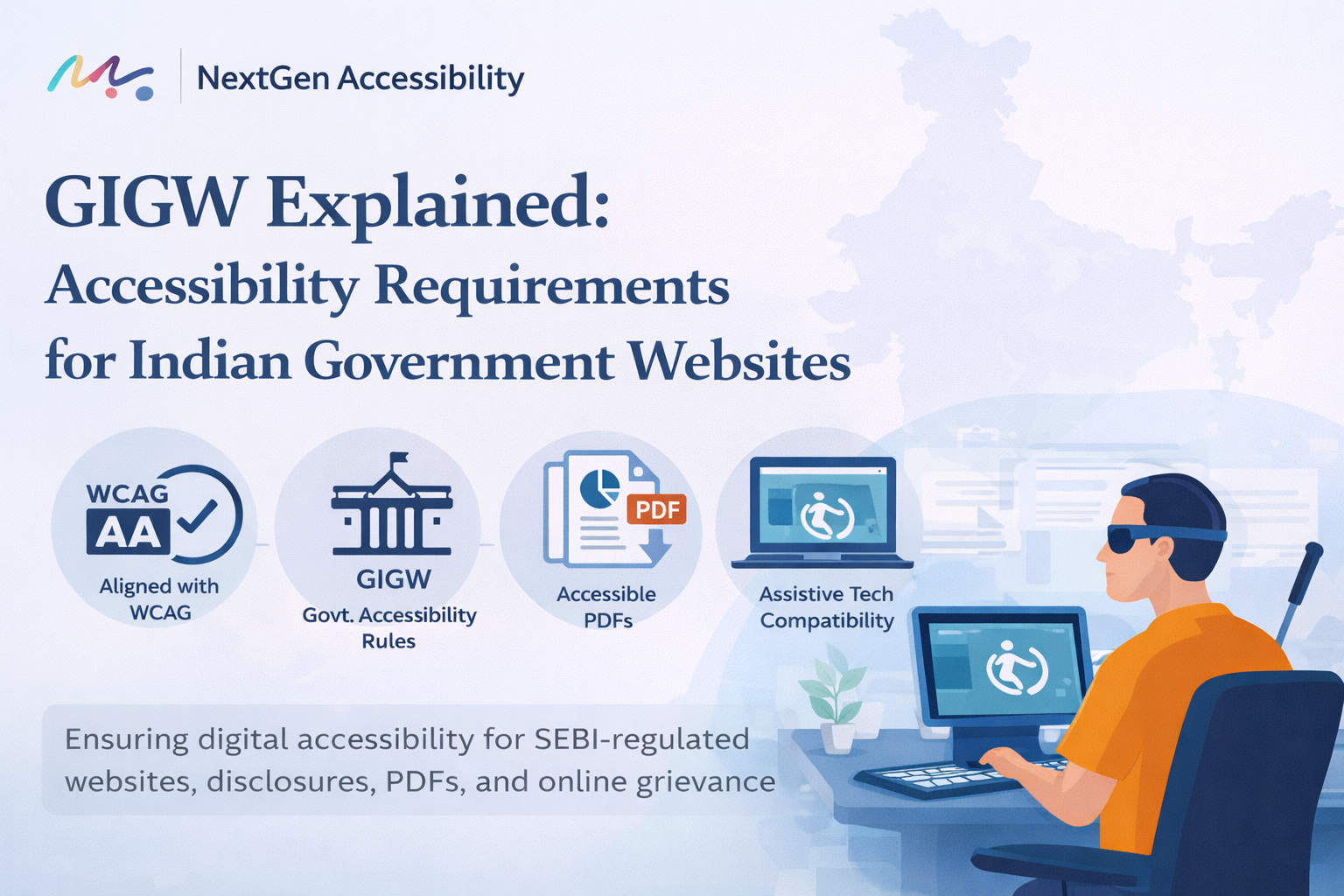
Understand GIGW accessibility requirements for Indian government websites and how WCAG standards support inclusive digital public services.
India’s digital governance ecosystem has grown rapidly over the last decade. Government services that were once delivered through physical offices are now accessed primarily through websites and online portals. As this shift continues, ensuring that these digital platforms are accessible to all users has become a critical responsibility of public institutions.
To address this need, the Government of India introduced the Guidelines for Indian Government Websites (GIGW)—a comprehensive framework that defines how government websites should be designed, developed, and maintained. Accessibility is a core pillar of GIGW, reflecting India’s commitment to inclusive digital access.
What Is GIGW?
The Guidelines for Indian Government Websites (GIGW) are issued by the Ministry of Electronics and Information Technology (MeitY) and apply to central and state government websites, portals, and digital platforms.
GIGW covers multiple aspects of website quality, including content standards, usability, security, performance, and accessibility. From an accessibility perspective, GIGW ensures that government websites are usable by persons with disabilities, senior citizens, and users relying on assistive technologies.
By standardising website practices, GIGW helps create consistent, reliable, and inclusive public digital services across India.
Why Accessibility Matters for Government Websites
Government websites are often the primary gateway for citizens to access public services, information, and benefits. These platforms must serve users across varying levels of digital literacy, devices, and abilities.
When a government website is inaccessible, it can prevent users with disabilities from completing essential tasks such as submitting applications, accessing notices, or filing grievances. This creates barriers to public services and undermines the principle of equal access.
Accessibility under GIGW is therefore not just a technical requirement—it is a public service obligation and a reflection of good governance.
GIGW and WCAG Alignment
GIGW is closely aligned with the Web Content Accessibility Guidelines (WCAG), which are globally recognised standards for digital accessibility. In practice, GIGW adopts principles consistent with WCAG 2.1 Level AA.
These principles ensure that content is perceivable, operable, understandable, and robust. This includes providing text alternatives for images, ensuring sufficient colour contrast, enabling keyboard navigation, maintaining logical content structure, and ensuring compatibility with assistive technologies.
By aligning with WCAG, GIGW ensures that Indian government websites meet internationally accepted accessibility benchmarks.
Common Accessibility Requirements Under GIGW
GIGW accessibility requirements include ensuring that all non-text content has text alternatives, websites can be fully navigated using a keyboard, and content remains readable when text is resized.
Websites must have clear heading structures, meaningful page titles, consistent navigation, and visible focus indicators. Forms and interactive elements must be accessible to screen readers and provide clear error messages.
Documents published on government websites, including PDFs, should be properly structured, tagged, and readable by assistive technologies.
Common Accessibility Challenges
Despite clear guidelines, many government websites continue to face accessibility challenges. These often include scanned PDF documents without selectable text, missing document structure, poor colour contrast, and inaccessible navigation menus.
Such issues can limit independent access for users with disabilities and reduce overall usability for all citizens.
Ongoing Compliance and Maintenance
Accessibility compliance under GIGW is not a one-time activity. Government websites are regularly updated with new content, services, and features. Without continuous monitoring, accessibility issues can reappear.
Regular accessibility audits, testing with assistive technologies, and accessibility awareness among content creators are essential for sustained compliance.
Conclusion
GIGW plays a vital role in ensuring that Indian government websites are accessible, inclusive, and citizen-centric. By aligning with WCAG standards and embedding accessibility into digital governance, GIGW supports equal access to public services.
Accessible government websites not only meet compliance requirements but also strengthen trust, transparency, and inclusivity in India’s digital ecosystem.